
Arriving in Portugal for the first time, you’ll immediately notice that the country has a very reliable and affordable way to move between cities and regions.
Through a well-structured network of trains, metros, buses, and ferries, it’s easy to get from Lisbon to the Spanish border or from Faro to Braga.
While only Lisbon and Porto have metro networks, public transport in many smaller cities and towns is provided by dependable bus networks.
In this article, we’ll explain all the modes of public transport in Portugal, the areas that they cover, and how much it costs to get around easily.
Portugal Public Transportation Options
Portugal has several interconnected systems, and depending on where you are going, it will determine how you use each of them.
For example, if you need to go to Lisbon Airport and use the national CP train network, you’ll need to get off at Lisboa Oriente station and transfer to Lisbon’s metro to complete your journey.
Portugal’s train system
Comboios de Portugal (CP) is the national rail operator and runs regional, intercity, and high-speed services that connect most of the country through over 560 stations.
High-speed trains operate between major cities like Lisbon, Porto, Coimbra, and Faro, while intercity and regional trains service smaller towns.
You can purchase tickets online, at stations, or through the mobile app, and there are discounts available for students, seniors, and early bookings.
Metro networks
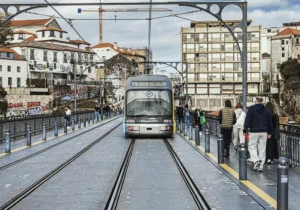 Portugal has only two metro networks, one in Lisbon and one in Porto, but both are modern, efficient, and easy to use.
Porto’s metro operates more like a light rail system than a traditional underground network. It has six lines connecting the city center to surrounding areas such as Vila Nova de Gaia, Matosinhos, and Maia.
Trains are frequent, clean, and run both underground in central areas and above ground in suburban zones. It is also easy to get to the city’s center from Porto’s international airport.
Lisbon’s metro is slightly more compact but covers the city's most important parts. It consists of four lines, each identified by a color, and connects residential neighborhoods, business districts, and key transport hubs.
If you arrive at Lisbon’s airport, you can take the Red Line (Linha Vermelha) directly into the city. From there, you can transfer to other lines depending on your destination.
For daily commuting, the metro is usually the fastest option, especially during peak hours when road traffic slows buses significantly.
Local buses and trams
In most cities and smaller towns, buses fill the gaps that metro and train lines don’t cover. They reach residential areas, business parks, and smaller neighborhoods that are not connected by rail.
In Lisbon, the bus network is managed by Carris and operates over 140 lines. Porto’s 75-route bus system is operated by STCP, and some of the most scenic routes for tourists include the 500 along the river from Ribeira to Matosinhos, and the 904, which goes from Bolhão to Coimbrões.
Currently operating in Lisbon, Porto, and Sintra, trams are also part of the public transport network and a great way to experience a city’s scenery.
Long-distance buses
If you need to go where trains don’t have convenient stations, long-distance buses are a practical alternative. They connect major cities and smaller towns across the country and are comfortable, with air conditioning and assigned seating on longer routes.
The most popular operator is Rede Expressos, but the unmistakable green buses of FlixBus are a regular sight on Portugal’s highways.
Prices are often competitive with trains and, in some cases, cheaper, especially if you book in advance. For example, if you don’t mind a journey of three hours and 15 minutes, it will cost you €19 to go from Lisbon Oriente to Porto Campanhã. However, the same journey on CP will cost €35, but it’s only 2.5 hours.
Public Transport Connections from Airports
 Both Lisbon and Porto airports are well connected to the public transport network, which makes it easy to reach the city without arranging private transfers.
In Lisbon, Humberto Delgado Airport is directly connected to the metro and is just four metro stops from Lisboa Oriente station, one of the main transport hubs.
From there, you can reach central areas such as Saldanha or Alameda in under 20 minutes, or you can access the national rail network and travel to cities like Porto, Coimbra, or Faro.
In Porto, Francisco Sá Carneiro Airport is connected to the metro through Line E. This line runs directly into the city center and continues through key areas, making it one of the simplest airport transfers in Portugal.
In both cities, buses and taxis are also available, but in most cases, the metro is the fastest and most cost-effective option.
Cost of Public Transport in Portugal
One of the main advantages of public transport in Portugal is its affordability, especially compared to other Western European countries.
For single journeys within cities like Lisbon or Porto, you can expect to pay around €1.50 to €2.00 for a metro, bus, or tram ride when using a rechargeable Navegante travel card.
If you plan to use public transport regularly, daily and monthly passes offer much better value. A 24-hour pass in Lisbon, which covers metro, buses, and trams, typically costs around €6 to €7.
Monthly passes are widely used by residents and cost approximately €30 to €40, depending on the zones you select. These passes allow unlimited travel within your chosen area and are the most cost-effective option for commuting.
High-speed trains between Lisbon and Porto generally cost €25 to €40 when booked in advance, while intercity trains are slightly cheaper. Regional trains, which serve smaller towns, offer the lowest fares and are often used for short-distance travel.
Long-distance buses follow a similar pricing structure. Tickets between major cities can cost anywhere from €10 to €30, depending on demand and how early you book.
Pros and Cons of Public Transport in Portugal
 Like any system, public transport in Portugal has clear advantages, though it has a few limitations depending on where you live.
One of the main benefits is cost. Compared to other Western European countries, public transport remains affordable, even for daily use.
For example, a high-speed train from Madrid to Barcelona, which takes around 2.5 to 3 hours, often costs between €40 and €90. In France, a comparable journey from Paris to Lyon, with a travel time of about 2 hours, typically costs between €50 and over €100 on the TGV.
Coverage is another strength, particularly in urban areas. Lisbon and Porto offer extensive networks that make it possible to move around without relying on a car.
On the other hand, if you live outside major cities, you may find that services are less frequent. Buses in smaller towns run less frequently, and some areas are poorly connected by rail.
Public Transport in Portugal for Expats and Long-Term Residents
If you are planning to live in Portugal, public transport will likely become part of your daily routine, especially if you are based in Lisbon or Porto.
Monthly passes, train tickets, and even some local transport options can be purchased online or through mobile apps. In some cases, when setting up accounts or subscriptions tied to transport services, you require a Portuguese tax identification number (NIF).
We can help you get a NIF and also open a Portuguese bank account. That way, when paying for public transport, you avoid unnecessary exchange rate fees, and you are guaranteed that a local bank card will work with tap-and-go systems.

Frequently Asked Questions About Public Transport in Portugal
Is public transport in Portugal reliable?
Yes, public transport in Portugal is generally reliable, especially in Lisbon and Porto. Metro, train, and bus services run frequently, and most systems are well-maintained. Occasional delays or strikes can occur, but they are usually announced in advance.
How much does public transport cost in Portugal?
Public transport in Portugal is affordable. A single journey in cities like Lisbon or Porto costs around €1.50 to €2.00 using a travel card, while monthly passes typically range from €30 to €40 depending on the zones covered.
What is the best way to get around Portugal without a car?
The best way to get around Portugal without a car is by using a combination of trains, metros, and buses. Trains connect major cities, while metro and bus networks cover urban areas efficiently.
Is there a metro in Porto?
Yes, Porto has a metro system. It operates as a light rail network with six lines connecting the city center, suburbs, and the airport. It is one of the easiest ways to travel around Porto.
How do you pay for public transport in Portugal?
You can pay using rechargeable travel cards like Viva Viagem in Lisbon or Andante in Porto. Contactless bank cards are also accepted in many areas, but travel cards are usually cheaper for regular use.
Can tourists use public transportation in Portugal easily?
Yes, tourists can easily use public transportation in Portugal. The system is user-friendly, with clear signage, English translations, and simple ticketing options available at stations and online.
Is public transport in Portugal safe?
Public transport in Portugal is considered safe. Incidents are rare, but like in any country, you should stay aware of your belongings, especially in busy areas or during peak hours.
How extensive is the Portugal train system?
The Portuguese train system covers most of the country, with over 500 stations connecting major cities and smaller towns. High-speed, intercity, and regional trains provide options depending on distance and budget.
Do you need a NIF to use public transport in Portugal?
You do not need a NIF for basic public transport use, such as buying single tickets. However, some online services, subscriptions, or account-based transport apps may require a NIF for registration.
Is public transport better than driving in Portugal?
Public transport is often better than driving in cities like Lisbon and Porto due to traffic and limited parking. However, in rural areas, having a car can be more practical due to less frequent public transport.